
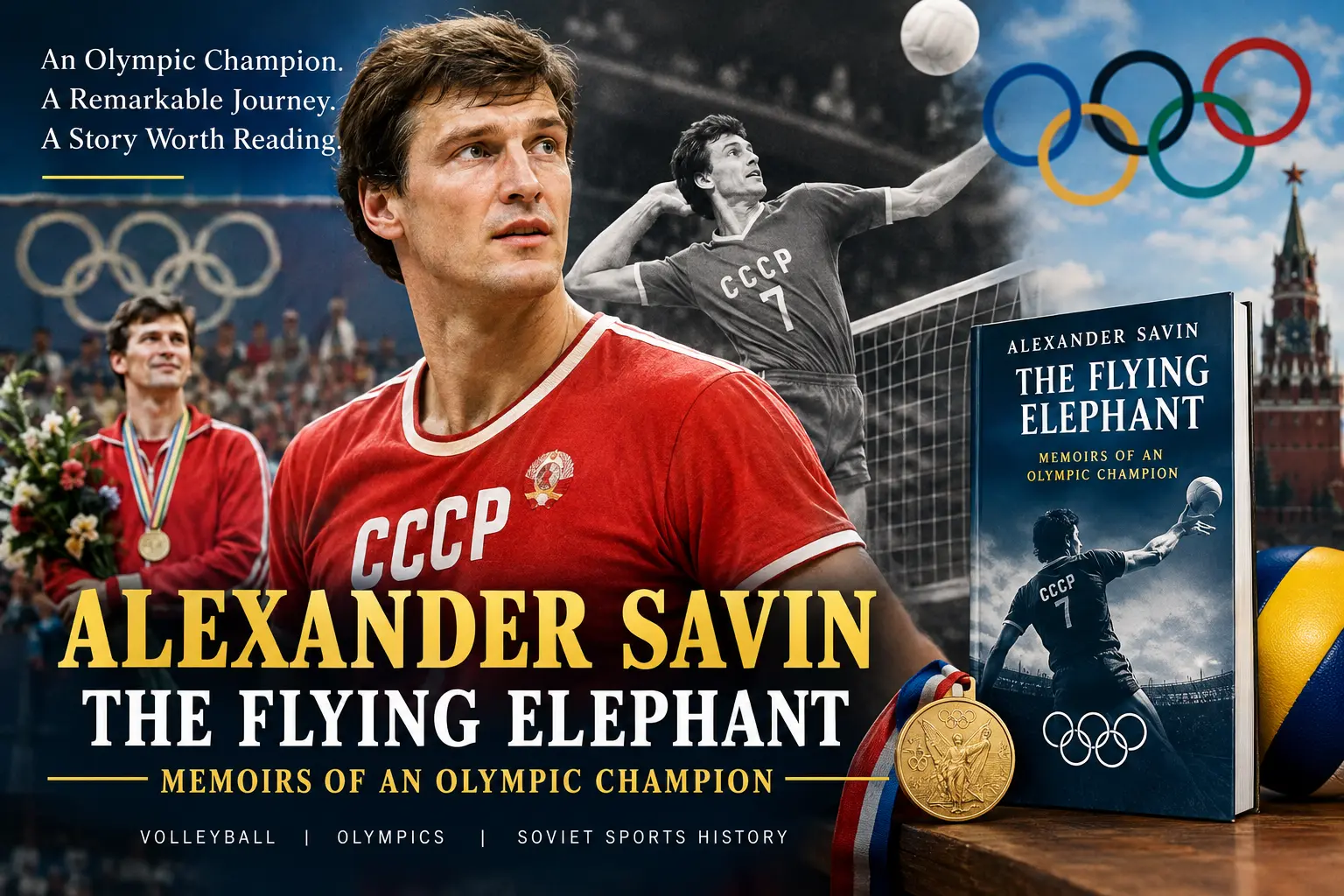
Alexander Savin: The Flying Elephant – Memoirs of an Olympic Champion is a sports memoir centered on one of the notable figures of Soviet-era volleyball. Savin represented the Soviet Union at two Olympic Games, winning a silver medal at Montreal 1976 and gold at Moscow 1980. He was later inducted into the International Volleyball Hall of Fame in 2010.
The book is particularly interesting because it connects Savin’s personal memories with a significant period in international volleyball. Instead of looking at his career only through Olympic results, The Flying Elephant provides a memoir-based perspective on the athlete, his teams, his competitive environment, and the experiences surrounding elite volleyball.
For readers searching for Alexander Savin, The Flying Elephant, Olympic volleyball, Soviet volleyball history, or sports memoirs, understanding both the man and the book is important.
Who Is Alexander Savin?
Alexander Borisovich Savin was born on July 1, 1957, in Taganrog, Russia. He became a prominent Soviet volleyball player and later received recognition from the International Volleyball Hall of Fame, which inducted him in 2010 as a male indoor player.
Savin’s international career reached its Olympic milestones at two consecutive Games.
At the 1976 Montreal Olympics, he made his Olympic debut with the Soviet Union men’s volleyball team. The Soviet team reached the gold-medal match after progressing through the tournament, but Poland won the final in five sets. Savin therefore left Montreal with an Olympic silver medal.
Four years later, the story changed.
At the 1980 Moscow Olympics, Savin again played throughout the tournament as the Soviet Union advanced to the final. The Soviet team defeated Bulgaria 3–1 to win the Olympic gold medal on home soil.
That progression—from Olympic silver in Montreal to Olympic gold in Moscow—is an important part of Savin’s sporting story.
Alexander Savin at a Glance
| Detail | Information |
|---|---|
| Full name | Aleksandr Borisovich Savin |
| Born | July 1, 1957 |
| Birthplace | Taganrog, Russia |
| Sport | Volleyball |
| National team | Soviet Union |
| Olympic debut | Montreal 1976 |
| Olympic result in 1976 | Silver |
| Olympic result in 1980 | Gold |
| Position | Volleyball player |
| Hall of Fame | International Volleyball Hall of Fame, 2010 |
The International Volleyball Hall of Fame’s biography confirms Savin’s Olympic participation and medal record.
What Is The Flying Elephant – Memoirs of an Olympic Champion?
The Flying Elephant – Memoirs of an Olympic Champion is presented as Alexander Savin’s memoir of his life and career in volleyball.
That distinction matters.
A biography is normally written by someone researching another person’s life. A memoir, by contrast, emphasizes the author’s own memories, experiences, observations, and reflections. In this case, the subject is especially interesting because Savin experienced major international volleyball competitions from inside the Soviet sporting system.
Available descriptions of the English Kindle edition report a 514-page edition with more than 240 photographs, giving the book a substantial visual as well as autobiographical dimension. Current book-related sources report an English Kindle publication date of October 26, 2025; because edition information can change, readers should verify current retailer details before purchasing.
The book therefore sits at the intersection of several topics:
- Alexander Savin’s personal story
- Olympic volleyball
- Soviet volleyball history
- athlete memoirs
- international competition
- training and preparation
- teammates and coaches
- life in elite sport
- sporting memories
- the transition beyond competitive athletics
For someone who has searched for “Alexander Savin The Flying Elephant Memoirs of an Olympic Champion,” these connections explain why the book is more than a simple account of one Olympic final.
Why Is Alexander Savin Called “The Flying Elephant”?
The unusual title naturally raises another question: Why “The Flying Elephant”?
Available descriptions of Savin’s career connect the nickname with the contrast between his large physical presence and his ability to move and jump effectively on the volleyball court. One account attributes the nickname to the Italian sports press, specifically La Gazzetta dello Sport.
The phrase works because it captures a striking sporting contrast.
An elephant suggests size and strength. “Flying” suggests elevation, movement, and agility.
In volleyball, that contrast can be particularly meaningful for a front-row player. Height and physical power are valuable, but successful play also requires timing, coordination, movement, anticipation, and the ability to react quickly.
It is important, however, to distinguish a documented nickname explanation from a personal interpretation of the book’s title. Unless Savin explicitly gives a different explanation in the memoir, readers should treat broader symbolic readings of “The Flying Elephant” as interpretations rather than established authorial intent.
Alexander Savin’s Olympic Journey
Savin’s Olympic career is one of the clearest reasons his memoir attracts attention.
Montreal 1976: Olympic Silver
Savin’s Olympic debut came at the 1976 Montreal Games.
According to the International Volleyball Hall of Fame, Savin played in all five matches for the Soviet team. The Soviet Union moved through pool play and defeated Cuba in the semifinal, setting up a gold-medal match against Poland. Poland won the final 3–2, leaving Savin and the Soviet team with silver.
The result placed Savin inside one of the important Olympic volleyball matches of the period.
The International Volleyball Hall of Fame describes the 1976 men’s volleyball final as a major Cold War-era contest between two leading international teams.
Moscow 1980: Olympic Gold
Four years later, Savin returned to the Olympics with the Soviet Union.
This time, the outcome was different.
The Soviet team opened the 1980 Olympic tournament with a 3–1 victory over Czechoslovakia and then progressed through pool play before advancing through the knockout stage. Savin played in all six matches, according to his Hall of Fame biography. The Soviet Union ultimately defeated Bulgaria 3–1 in the final to win the gold medal.
Winning gold at home made the Moscow Games a defining point in Savin’s Olympic career.
His two Olympic appearances therefore create a simple but compelling timeline:
1976 Montreal → Silver
1980 Moscow → Gold
That progression gives readers useful historical context before they approach the memoir.
Savin and the Golden Era of Soviet Volleyball
The importance of The Flying Elephant also comes from its historical setting.
Savin competed during a period when the Soviet Union was a major force in men’s international volleyball. His Olympic career was surrounded by success in other major competitions as well.
Before the 1980 Olympics, the Soviet team had won the 1977 FIVB World Cup and the 1978 FIVB World Championship, while Savin also helped the Soviet side win European Championship titles in 1977 and 1979.
This context changes how readers can understand the memoir.
Savin was not simply an athlete who happened to win one Olympic medal. He was part of a highly successful international volleyball program during an important period in the sport’s history.
His memoir can therefore be read on two levels:
- Personal history — Savin’s experiences as an athlete.
- Sports history — a window into Soviet volleyball during the 1970s and 1980s.
That combination is particularly valuable for readers interested in historical sports narratives.
What Makes an Olympic Memoir Different From a Medal Record?
An Olympic results page can tell us whether an athlete won gold, silver, or bronze.
It cannot tell us everything about the experience.
A memoir provides a different kind of evidence: personal memory.
That can include observations about training, teammates, coaches, competition, preparation, travel, relationships within a team, and the way an athlete remembers important moments.
This is why The Flying Elephant is best understood as a complement to official sporting records rather than a replacement for them.
Savin’s Olympic medals are independently documented. His memoir provides the personal perspective that official results cannot provide.
At the same time, readers should remember that memoirs are inherently subjective. Memory can emphasize some events and leave others less prominent. A personal account is valuable precisely because it represents the author’s experience, but it should not automatically be treated as a neutral account of every historical event.
The Role of Training and Preparation
Elite volleyball does not begin when players walk onto an Olympic court.
The Olympic performance represents the end result of years of preparation.
Savin’s career demonstrates this broader reality. His Olympic appearances followed years of international competition, national-team development, club volleyball, and major championship experience. His Hall of Fame biography documents important milestones leading into the 1980 Olympics, including European, World Cup, and World Championship success.
This background is important when discussing the memoir because it places Olympic success in context.
The gold medal in Moscow was not an isolated event.
It came after years of competitive development.
For young volleyball players, coaches, and sports fans, this is one of the most useful ideas to take from Savin’s career: elite performance is usually built through repeated competition and accumulated experience rather than a single breakthrough.
Teamwork Is Central to Savin’s Story
Volleyball is fundamentally a team sport.
An Olympic medal belongs to a team even when individual players become particularly famous.
Savin’s career illustrates that reality. His Olympic achievements came as part of the Soviet Union men’s volleyball team, and his Hall of Fame biography also highlights his relationships with teammates and the wider national program.
That makes teamwork an important semantic connection surrounding the memoir:
Alexander Savin → volleyball → Soviet national team → teammates → coaches → Olympic competition → team achievement.
This is also why readers should avoid reducing the story to individual athletic talent.
Volleyball depends on coordination. Players must understand one another’s movements, tactical roles, timing, and responsibilities. At Olympic level, those relationships become even more important because the margin for error is extremely small.
The Human Side of Olympic Success
Medals are easy to count.
The experiences behind them are harder to measure.
That is where a memoir can add depth.
Alexander Savin’s story places a human being behind the Olympic statistics. His career includes both a painful loss in the 1976 Olympic final and a gold-medal victory four years later.
That sequence alone provides an important perspective on competitive sport.
Winning and losing are not separate worlds. They can be connected stages of the same career.
The 1976 silver medal did not end Savin’s Olympic story. The Soviet team returned to the next Games and won gold in Moscow.
For readers, this creates a useful distinction between a result and a career.
One match can determine a medal.
A career is measured across years.
Soviet Volleyball and the Historical Context
Another reason the memoir can interest readers beyond volleyball is its connection with Soviet sports history.
International sport during the Cold War was closely connected to national identity and international prestige. Olympic competitions between major sporting powers often carried significance beyond the scoreboard.
Savin competed during this environment.
The 1976 Montreal final, for example, has been described by the International Volleyball Hall of Fame as a notable Cold War-era volleyball clash between Poland and the Soviet Union.
Understanding this historical setting can make the memoir more meaningful.
A reader isn’t simply looking at an old volleyball career. They are also looking at an athlete’s experiences during a distinctive period in international sport.
Who Should Read The Flying Elephant?
The memoir is likely to be most relevant to several groups of readers.
Volleyball Fans
Volleyball enthusiasts can use the book to explore the career of a player who competed at the highest international level.
Olympic History Readers
Anyone interested in the 1976 and 1980 Olympic Games can gain another perspective on an athlete who participated in both tournaments.
Sports Memoir Readers
Readers who prefer firsthand accounts can approach the book as a personal sports narrative rather than an outside biography.
Coaches and Athletes
The career provides examples of long-term competition, team participation, and the progression from Olympic silver to gold.
Sports Historians
The book’s connection with Soviet volleyball makes it potentially useful alongside independent records and historical sources.
What Can Readers Learn From Alexander Savin’s Career?
The value of an athlete’s story does not have to be limited to the sport itself.
Several broader ideas emerge from Savin’s documented career.
Persistence After Setbacks
Savin experienced Olympic disappointment in Montreal in 1976 before becoming an Olympic champion in Moscow in 1980.
That timeline illustrates how one major loss does not necessarily define an entire sporting career.
Long-Term Development
Savin’s Olympic success came within a wider international career that included major European and world competitions.
This highlights the role of accumulated experience.
Team Achievement
His Olympic medals were won as part of the Soviet national team, reinforcing the importance of teamwork in volleyball.
Historical Perspective
His career occurred during a major period in Soviet and international volleyball, giving the memoir relevance beyond personal achievement.
How Should You Read the Memoir as a Historical Source?
There is an important distinction between memoir and historical record.
A memoir tells readers how an author remembers and understands events.
An independent sports archive documents results and historical facts.
The two sources can work together.
For example, the International Volleyball Hall of Fame independently confirms Savin’s Olympic medals, participation, birthplace, and induction into the Hall of Fame.
A reader can then use the memoir to explore the personal side of that documented career.
This approach produces a stronger understanding than relying exclusively on either source.
Frequently Asked Questions
Who is Alexander Savin?
Alexander Savin, also known as Aleksandr Savin, is a former Soviet volleyball player born in 1957. He represented the Soviet Union at the 1976 and 1980 Olympic Games, winning silver in Montreal and gold in Moscow. He was inducted into the International Volleyball Hall of Fame in 2010.
What is The Flying Elephant – Memoirs of an Olympic Champion?
It is a memoir centered on Alexander Savin’s experiences and career in elite volleyball. Current descriptions of the English Kindle edition report a substantial 514-page edition containing more than 240 photographs.
What sport did Alexander Savin play?
Alexander Savin was a volleyball player who competed internationally for the Soviet Union.
Did Alexander Savin win an Olympic gold medal?
Yes. Savin won Olympic gold with the Soviet Union men’s volleyball team at the 1980 Moscow Olympics. He had previously won silver at the 1976 Montreal Olympics.
Why is the book called The Flying Elephant?
Available descriptions connect the nickname with the contrast between Savin’s large physical build and his agility and jumping ability as a volleyball player. One account attributes the nickname to the Italian sports press.
Is Alexander Savin in the Volleyball Hall of Fame?
Yes. The International Volleyball Hall of Fame inducted Aleksandr Savin in 2010 in its male indoor player category.
When did Savin compete in the Olympics?
He competed at Montreal 1976 and Moscow 1980. His team won silver in Montreal and gold in Moscow.
Is The Flying Elephant a biography or memoir?
It is presented as a memoir by Alexander Savin, meaning the central account comes from the athlete’s own perspective rather than being solely an outside biography.
Final Thoughts
Alexander Savin’s The Flying Elephant – Memoirs of an Olympic Champion is best understood through the combination of athlete, book, sport, and historical context.
Savin’s documented Olympic journey is straightforward: silver at Montreal 1976, followed by gold at Moscow 1980. But the significance of his story extends beyond those two medals.
His career unfolded during an important era of Soviet volleyball, and his memoir gives readers an opportunity to explore the person behind the results. For volleyball fans, Olympic-history readers, sports memoir enthusiasts, and anyone interested in the development of elite athletes, that combination makes The Flying Elephant a particularly relevant title to explore.
Most importantly, the book should not be reduced to a simple “Olympic champion story.” The real search intent behind Alexander Savin, The Flying Elephant, and Memoirs of an Olympic Champion is broader: readers want to understand who Savin was, what he achieved, what the memoir is about, and why his career matters in volleyball history.
That is where the book becomes more than a collection of sporting results—it becomes a personal perspective on a significant chapter of international volleyball.

Your favorite destination for viral pickup lines, dating humor, love quotes, and flirty chat ideas.