
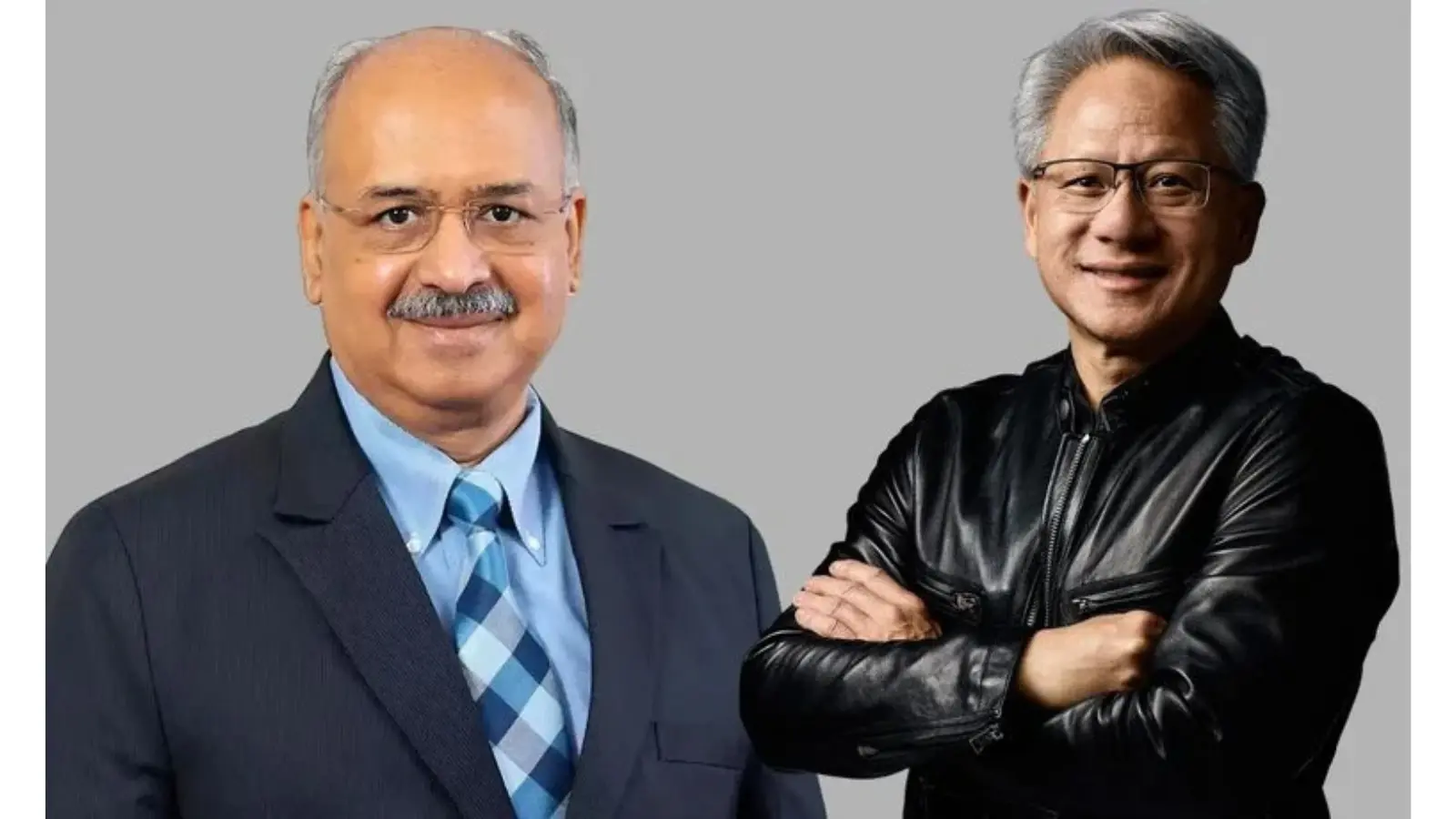
Dilip Shanghvi and Jensen Huang are two influential entrepreneurs whose companies have become major forces in different industries. Shanghvi founded Sun Pharmaceutical Industries, one of India’s leading pharmaceutical companies, while Huang co-founded NVIDIA, a technology company known for graphics processing units (GPUs), accelerated computing, and artificial intelligence infrastructure.
Although their careers developed in different markets, their business journeys share important themes. Both identified opportunities in industries requiring specialized knowledge, invested in long-term growth, and helped build organizations with international reach.
However, their achievements should be understood in the context of their respective industries. Shanghvi’s business success is closely associated with pharmaceutical manufacturing, acquisitions, and the development of medicine portfolios. Huang’s success is linked to semiconductor engineering, GPU computing, software ecosystems, and the growing demand for AI computing infrastructure.
This detailed comparison of Dilip Shanghvi and Jensen Huang explores their backgrounds, companies, estimated wealth, leadership approaches, business models, and lessons for aspiring entrepreneurs.
Who Is Dilip Shanghvi?
Dilip Shanghvi is an Indian businessman best known as the founder and executive chairman of Sun Pharmaceutical Industries Limited. He established the company in 1983 and helped transform it from a relatively small pharmaceutical venture into an international healthcare business.
His career demonstrates how specialized industry knowledge, product development, acquisitions, and gradual expansion can contribute to long-term business growth.
Early life and education
Dilip Shanghvi was born on October 1, 1955, in India. His father worked in pharmaceutical distribution, exposing him to the commercial side of the medicines industry.
Shanghvi studied commerce at the University of Calcutta. Rather than pursue a conventional corporate career, he decided to establish his own pharmaceutical business.
Forbes reports that he borrowed approximately $200 from his father to start Sun Pharmaceutical Industries in 1983. The business initially focused on psychiatric medicines, giving the company a defined market in which to develop its expertise.
This modest beginning is an important part of Shanghvi’s entrepreneurial story. His eventual success was not the result of a single product or transaction, but of years of business development and expansion.
Building Sun Pharmaceutical Industries
Sun Pharma began with a relatively narrow product focus before expanding into additional therapeutic areas and international markets.
Over the years, the company developed a broad portfolio that includes generic medicines, specialty pharmaceuticals, and treatments across multiple medical categories. It also expanded its manufacturing, research, and distribution capabilities.
One of the defining characteristics of Sun Pharma’s growth has been diversification. Operating across several pharmaceutical categories can help a company reduce dependence on individual products, although each market brings its own regulatory and competitive challenges.
Shanghvi’s approach also illustrates the importance of understanding customer needs. Pharmaceutical companies must consider doctors, patients, healthcare providers, regulators, and distribution partners when developing and marketing medicines.
Sun Pharma’s growth has therefore involved much more than increasing sales. It has required manufacturing capabilities, regulatory compliance, product development, and an ability to operate in multiple countries.
The Ranbaxy acquisition
One of Shanghvi’s most significant business decisions involved Sun Pharma’s acquisition of Ranbaxy Laboratories.
Announced in 2014 and completed in 2015, the transaction was valued at approximately $4 billion. It significantly expanded Sun Pharma’s scale and international presence.
The acquisition also demonstrates why corporate expansion requires careful execution. Integrating two pharmaceutical businesses involves manufacturing standards, product portfolios, regulatory obligations, distribution networks, and organizational management.
Acquisitions can accelerate growth, but their ultimate value depends on how effectively the combined business operates.
Today, Shanghvi remains closely associated with Sun Pharma’s strategic direction as its executive chairman. His career is an important example of entrepreneurship in India’s pharmaceutical industry.
Who Is Jensen Huang?
Jensen Huang is a Taiwanese-born American entrepreneur and the co-founder, president, and CEO of NVIDIA. He helped establish the company in 1993 and has led it through major changes in computer graphics, accelerated computing, and artificial intelligence.
Unlike Shanghvi, whose business centers on medicines, Huang operates in a technology sector where semiconductor performance, software development, and computing demand are major competitive factors.
Early life and education
Huang was born in Taiwan and spent part of his childhood in Thailand before moving to the United States.
He earned a bachelor’s degree in electrical engineering from Oregon State University and a master’s degree in electrical engineering from Stanford University.
Before founding NVIDIA, he worked at semiconductor companies Advanced Micro Devices and LSI Logic. These positions provided experience in the chip industry and helped him understand the technical and commercial challenges of semiconductor development.
His engineering background later became relevant to NVIDIA’s development of graphics processors and computing platforms.
Founding NVIDIA
Huang co-founded NVIDIA in 1993 with Chris Malachowsky and Curtis Priem.
The company initially focused on computer graphics, particularly technology used to render images for gaming and other visual applications.
In 1999, NVIDIA introduced a graphics processing unit, or GPU. GPUs became important in computer graphics because they can perform many calculations in parallel.
Their usefulness eventually extended beyond gaming. Researchers found that GPU architecture could accelerate scientific computing and certain machine-learning workloads.
This development helped NVIDIA move into broader computing markets. The company built an ecosystem around its hardware, including CUDA software, developer tools, networking technology, and integrated computing systems.
NVIDIA’s expansion into AI
The growth of artificial intelligence significantly increased demand for computing resources capable of training and running advanced AI models.
NVIDIA’s GPUs became important components of AI infrastructure because they can accelerate many of the mathematical operations used in machine learning. Its wider platform also helps developers and businesses deploy accelerated computing applications.
NVIDIA now serves markets that include gaming, data centers, scientific research, robotics, and AI development.
However, the company’s success also brings risks. It operates in a competitive semiconductor market and depends on complex global supply chains. Its results are influenced by customer investment, technology transitions, competition, and international trade restrictions.
Huang’s career demonstrates how a company can expand its original technology into new markets by investing in the capabilities those markets require.
Dilip Shanghvi and Jensen Huang: Key Differences
Although both entrepreneurs built globally influential companies, their business models and strategic priorities differ considerably.
| Comparison | Dilip Shanghvi | Jensen Huang |
|---|---|---|
| Main company | Sun Pharmaceutical Industries | NVIDIA |
| Industry | Pharmaceuticals and healthcare | Semiconductors and computing |
| Company founded | 1983 | 1993 |
| Core products | Generic and specialty medicines | GPUs, computing systems, and related software |
| Major growth drivers | Product expansion, acquisitions, international markets | Technical innovation, AI infrastructure, software ecosystem |
| Key expertise | Pharmaceutical markets and business development | Electrical engineering and semiconductor technology |
| Major risks | Regulation, product quality, competition, pricing | Technology competition, supply chains, export controls |
| Broader impact | Access to medicines and healthcare products | Computing, AI research, and digital infrastructure |
The central difference is the nature of the value each company provides.
Sun Pharma develops and supplies medicines, where safety, efficacy, manufacturing quality, and regulatory compliance are fundamental.
NVIDIA supplies computing technology, where performance, compatibility, software support, and the ability to meet growing computing demand are important competitive advantages.
Both industries require investment and technical expertise, but their development cycles, customers, and risks are not interchangeable.
Dilip Shanghvi Net Worth vs. Jensen Huang Net Worth
Net worth is a common reason readers search for Dilip Shanghvi and Jensen Huang together. Both entrepreneurs have accumulated substantial wealth through their connections to successful companies, but their fortunes are influenced by stock prices, ownership stakes, and market expectations.
Forbes reported estimated wealth of approximately $26.3 billion for Dilip Shanghvi and family on September 30, 2026. Its September 2026 estimates placed Jensen Huang’s personal fortune at roughly $187 billion to $190 billion, depending on the reporting date.
These figures are historical estimates rather than guaranteed current values. They should not be interpreted as cash held in personal bank accounts.
Why is Jensen Huang’s net worth higher?
Huang’s wealth is closely tied to his ownership of NVIDIA shares. As investors have assigned greater value to NVIDIA’s role in AI computing, the company’s market capitalization has increased substantially.
When a publicly traded company’s share price rises, the estimated value of an executive’s holdings can also rise, even if the executive has not sold any shares.
Shanghvi’s wealth is similarly connected to his ownership interest in Sun Pharma. However, pharmaceutical companies and semiconductor businesses are valued according to different growth expectations, risks, earnings prospects, and market conditions.
The difference between their fortunes does not, by itself, establish which entrepreneur is more capable. Wealth estimates reflect ownership, company valuation, market sentiment, and other assets.
For a current comparison, readers should check both Forbes profiles on the same day and confirm whether the figures refer to an individual or a family.
Leadership Styles: What Can We Learn From Both Entrepreneurs?
Dilip Shanghvi and Jensen Huang have followed different paths to business growth, but their careers illustrate the importance of matching strategy to an industry’s needs.
Dilip Shanghvi’s approach to business
Shanghvi’s business history emphasizes gradual expansion, industry knowledge, product diversification, and strategic acquisitions.
Pharmaceutical businesses often require significant time to develop products, establish manufacturing standards, meet regulatory requirements, and build distribution networks. As a result, growth must be supported by reliable execution.
Several lessons can be drawn from his approach:
- Understand the market: Knowledge of pharmaceutical distribution and customer needs can help identify commercial opportunities.
- Build specialized expertise: A focused starting market can provide a foundation for broader expansion.
- Diversify carefully: Additional products and therapeutic categories can reduce dependence on a single market.
- Evaluate acquisitions thoroughly: An acquisition can increase scale, but integration costs and operational challenges must be considered.
- Maintain quality: In healthcare, manufacturing standards and regulatory compliance are essential to sustainable business performance.
Shanghvi’s career shows that entrepreneurship does not always require disruptive technology. A business can also grow by serving established needs more effectively and expanding its capabilities over time.
Jensen Huang’s approach to innovation
Huang’s leadership is associated with long-term technology investment and the development of computing platforms that can serve new applications.
NVIDIA’s transition from graphics processing to accelerated computing illustrates the potential value of investing in technology before all its future uses become commercially obvious.
Important lessons from Huang’s approach include:
- Think beyond the original product: Technologies developed for one purpose may become useful in other industries.
- Invest in software as well as hardware: Software tools can make computing products easier to adopt and more valuable to developers.
- Build a strong ecosystem: Customers often consider compatibility, support, and available applications alongside hardware performance.
- Prepare for technological change: Businesses must adapt as customer needs and computing requirements evolve.
- Manage execution risks: Innovation depends on manufacturing capacity, skilled teams, supply-chain management, and dependable products.
Neither leadership approach is automatically better. Shanghvi’s strategy reflects the demands of pharmaceuticals, while Huang’s reflects the opportunities and uncertainties of advanced computing.
Sun Pharma vs. NVIDIA: Comparing Their Business Models
Understanding the companies behind these entrepreneurs provides a clearer explanation of their success.
How Sun Pharma generates business value
Sun Pharma develops, manufactures, and markets pharmaceutical products. Its business combines established generic medicines with specialty products and research-driven opportunities.
The company competes through product availability, manufacturing capabilities, regulatory compliance, distribution, and its ability to develop or acquire valuable products.
Generic medicines can face pricing pressure when competing products enter the market. Specialty medicines may offer different commercial opportunities, but they can also require substantial research investment and face clinical, regulatory, and market-access challenges.
A sustainable pharmaceutical strategy must balance existing products with future opportunities while maintaining high manufacturing standards.
How NVIDIA generates business value
NVIDIA sells computing technology that supports gaming, AI, data centers, and other accelerated computing applications.
Its business extends beyond individual chips. GPUs work alongside software, networking, developer tools, and computing systems designed to help customers run demanding applications.
This integrated ecosystem can strengthen customer relationships and make switching platforms more difficult. However, it does not eliminate competition or guarantee future growth.
NVIDIA must continue investing in technology while managing manufacturing dependencies, competition, export restrictions, and changes in customer spending.
The contrast is clear: Sun Pharma’s value comes from pharmaceutical products and healthcare capabilities, while NVIDIA’s comes from computing technology and the ecosystem surrounding it.
Lessons for Entrepreneurs and Business Students
The experiences of Shanghvi and Huang offer several practical lessons for people building businesses.
1. Start with a real need. Successful companies provide products or services that solve meaningful problems. Understanding customers is more important than choosing a business simply because it is fashionable.
2. Build expertise before expanding. Industry knowledge helps entrepreneurs recognize risks, assess opportunities, and make better decisions.
3. Choose a growth strategy that fits the market. Acquisitions may work well for some companies, while internal product development or technology innovation may be more suitable for others.
4. Invest for the long term. Research, manufacturing capabilities, software ecosystems, and international distribution can require years of investment before delivering their full value.
5. Recognize that success involves risk. Both pharmaceuticals and semiconductors face competition, regulation, and operational uncertainty. A strong business strategy identifies these risks rather than assuming growth will continue indefinitely.
6. Build systems that can scale. A company needs capable employees, effective management, reliable operations, and sound governance to grow beyond its founder’s individual contribution.
These lessons are more useful than copying the visible habits of successful billionaires. Entrepreneurs should apply the underlying principles to their own industries, resources, and customer needs.
Frequently Asked Questions
Who is Dilip Shanghvi?
Dilip Shanghvi is an Indian entrepreneur who founded Sun Pharmaceutical Industries in 1983. He serves as its executive chairman and is known for helping develop the business into a major international pharmaceutical company.
Who is Jensen Huang?
Jensen Huang is a Taiwanese-born American entrepreneur who co-founded NVIDIA in 1993. He serves as its president and CEO and is known for leading the company’s development in GPU computing and AI infrastructure.
Are Dilip Shanghvi and Jensen Huang business partners?
There is no established evidence presented here that they are business partners. They are known for leading companies in different industries: Sun Pharma in pharmaceuticals and NVIDIA in computing technology.
Who is richer, Dilip Shanghvi or Jensen Huang?
The Forbes estimates cited above place Jensen Huang’s personal wealth substantially higher than Dilip Shanghvi’s estimated family wealth in September 2026. Exact comparisons depend on the reporting date and whether the figures cover an individual or a family.
What companies did Dilip Shanghvi and Jensen Huang establish?
Shanghvi founded Sun Pharmaceutical Industries in 1983. Huang co-founded NVIDIA in 1993 with Chris Malachowsky and Curtis Priem.
What are their biggest business achievements?
Shanghvi’s major achievement is the development of Sun Pharma into an international pharmaceutical business through product expansion and acquisitions. Huang’s is the transformation of NVIDIA from a graphics-chip company into a major provider of accelerated computing and AI technology.
What can entrepreneurs learn from their success?
Entrepreneurs can learn the value of industry expertise, long-term investment, strategic decision-making, product development, and adapting to market changes. Their careers also show that different industries require different approaches to growth.
Conclusion
Dilip Shanghvi and Jensen Huang demonstrate how entrepreneurs can build influential companies by understanding their markets and investing in long-term opportunities.
Shanghvi developed Sun Pharma through pharmaceutical expertise, product expansion, acquisitions, and international growth. Huang helped transform NVIDIA through semiconductor innovation, GPU computing, software development, and investments in AI infrastructure.
Their companies operate under different commercial conditions, and their wealth reflects different ownership stakes and market valuations. Yet both careers demonstrate the importance of strategic thinking, industry knowledge, adaptability, and effective execution.
For anyone researching Dilip Shanghvi and Jensen Huang, the most useful comparison goes beyond billionaire rankings. Their stories show that successful entrepreneurship has no single formula: the strongest strategy depends on the problem being solved, the market being served, and the capabilities a company builds over time.

Explore funny pickup lines, smooth flirting tips, cheesy one-liners, and romantic messages for every occasion.