
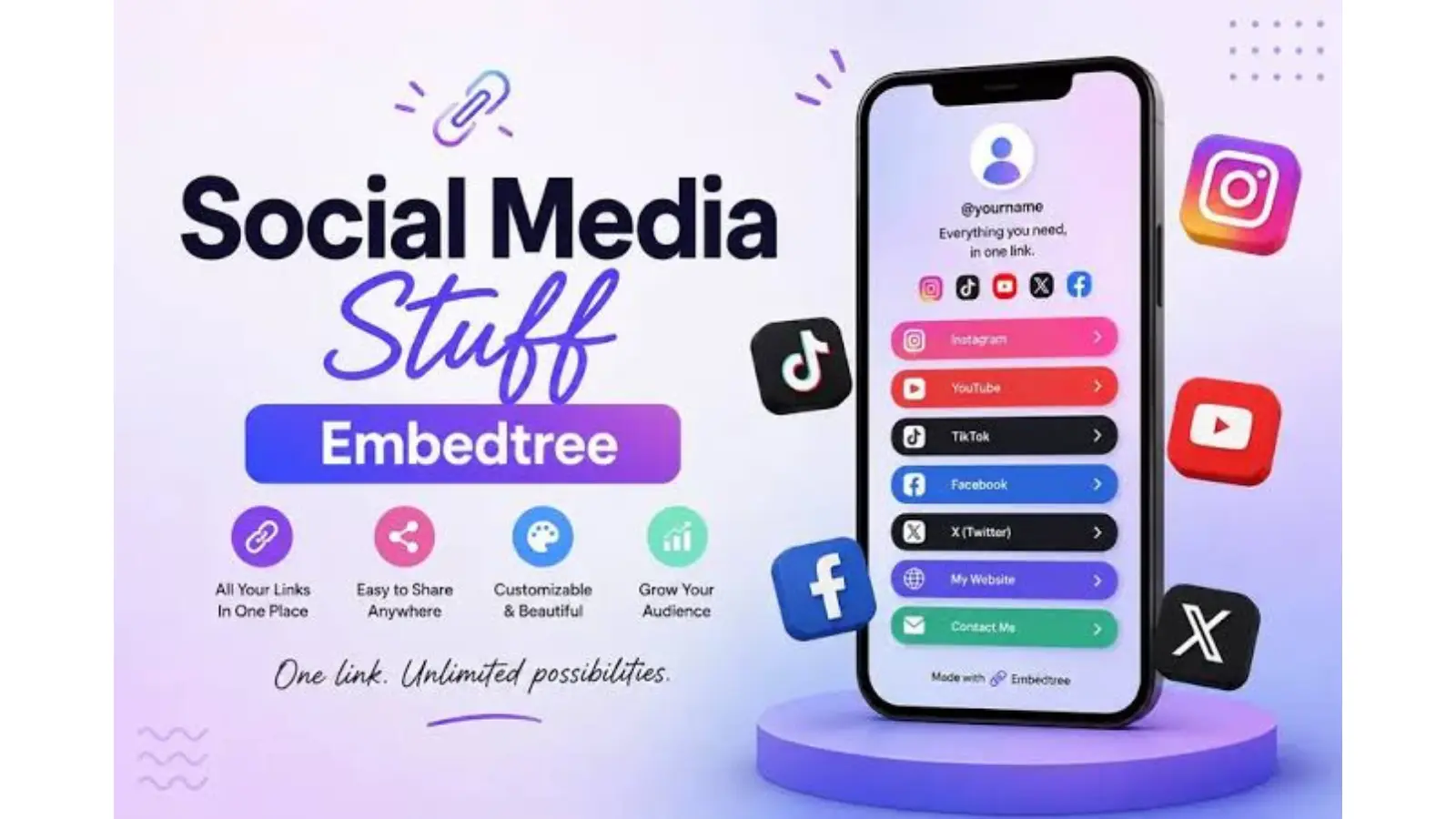
Social Media Stuff EmbedTree refers to the social media content category on EmbedTree.com, a website that publishes articles about social media, technology, games, software, and related digital topics.
The category includes articles about influencer marketing, Instagram growth, content strategy, social applications, and tools used by creators and businesses.
Readers searching for this phrase may want to explore the category, understand the website, or learn about the EmbedTree concept described in one of its articles.
Understanding these distinctions helps visitors find relevant information without confusing published articles with independently verified software features.
What Is Social Media Stuff EmbedTree?
Social Media Stuff is a dedicated category on the official EmbedTree website. It organizes articles covering different aspects of social media and digital communication.
You can visit the official Social Media Stuff category to browse its published content.
Unlike a single article about Instagram, TikTok, or Facebook, a category page groups related posts so readers can explore multiple subjects in one place. EmbedTree also has separate sections for Games & Software and Tech Tips & Tricks, reflecting its broader editorial focus.
The Social Media Stuff category includes several types of content:
- Social media marketing and business development
- Influencer marketing and agency selection
- Instagram growth and audience engagement
- Content strategy and distribution
- Social applications and live video communication
- Digital tools and resources for creators
- Social media use by freelancers and businesses
The selection of topics makes the category relevant to readers who want to understand social platforms, discover marketing ideas, or explore practical digital resources.
It is important, however, to distinguish the category itself from any particular product. The presence of social media articles does not automatically mean that every feature discussed in those articles is offered directly by EmbedTree.
Why Are People Searching for Social Media Stuff EmbedTree?
The phrase combines a broad topic with a specific website name, which can create uncertainty about what the searcher will find.
Some people may be looking for the official category page. Others may have encountered an article about EmbedTree and want to understand its purpose. A third group may be interested in social media links, embedded content, or tools for organizing an online presence.
These different intentions matter because each requires a different answer.
Finding the official category
Visitors who want to read social media articles can go directly to EmbedTree’s category archive. This is the most straightforward starting point for discovering its published content.
Understanding the website
Readers may want to know whether EmbedTree is a blog, a social network, or a software service. The public category archive clearly presents articles with headlines, author attributions, summaries, and reading-time estimates.
Exploring the EmbedTree concept
One article in the category is titled EmbedTree For Social Media: Build One Link That Shows All Your Social Stuff (2026 Guide). Its description presents the idea of gathering social media links and content on one page.
That article is relevant to readers interested in social-link organization. However, a description of a concept or service is not, by itself, proof that a fully operational product with particular integrations, analytics, or subscription plans is available.
Understanding the reason behind the search helps readers avoid confusing different meanings of the same term.
What Topics Does EmbedTree’s Social Media Stuff Category Cover?
The category brings together articles addressing several related areas of online communication. The following examples are based on article titles and descriptions visible in the official category archive.
1. Social media marketing
Social media marketing involves using digital platforms to communicate with an audience, develop brand awareness, promote products, and support business objectives.
EmbedTree lists an article titled Social Media Marketing Services: A Full Guide for Company Development. Its subject is relevant to businesses exploring how social platforms can contribute to their online presence.
Readers researching marketing services should also consider their business goals, target audience, available budget, and the quality of the provider’s work before choosing an agency.
2. Influencer marketing and agencies
Influencer marketing involves collaborating with creators whose audiences may be interested in a brand’s products or services.
EmbedTree’s category includes Top Social Media Influencer Agencies for Brands in 2026. This topic is particularly relevant to businesses that want to understand the role of specialist agencies in creator partnerships.
When comparing agencies, businesses should examine relevant experience, campaign objectives, audience quality, reporting methods, and contract terms. A large follower count alone does not establish whether a partnership will deliver meaningful results.
3. Instagram growth
The category includes an article titled How to Grow and Increase Instagram Followers: A Realistic Guide That Works.
Instagram growth can involve publishing relevant content, developing a recognizable profile, interacting with the intended audience, and learning from performance data.
A useful growth strategy focuses on attracting relevant followers rather than purchasing artificial engagement. Fake followers may increase a visible number without building a genuinely interested audience.
Readers should evaluate specific growth recommendations carefully and avoid techniques that violate platform rules.
4. Content strategy and distribution
Publishing more content does not automatically produce better results. Content must reach the right audience and provide a reason for people to engage with it.
EmbedTree lists 5 Signs Your Content Strategy Needs Distribution, Not More Volume, a topic that addresses the relationship between content production and distribution.
For businesses and creators, this distinction is important. A useful article or video may perform poorly if it is not presented to the appropriate audience or shared through suitable channels.
A practical approach is to identify the intended audience, choose suitable distribution channels, adapt the format to each platform, and measure the results.
5. Live video chat and social applications
The category also features How Live Video Chat Works Inside Social Apps: Rooms, Filters and Moderation.
Live video features involve more than simply transmitting a camera feed. Depending on the application, users may encounter group rooms, moderation controls, filters, privacy settings, and communication permissions.
Anyone evaluating a live video application should understand who can join a conversation, whether rooms are public or private, how moderation works, and what information other participants can access.
These details are particularly important when a platform is used by young people or for professional communication.
6. Tools for social media freelancers
Freelancers may manage client accounts, prepare content, coordinate schedules, and communicate with clients while working remotely.
EmbedTree’s category includes Wi-Fi, Wandlust & Deadlines: The Essential Tools Every Traveling Social Media Freelancer Needs.
The subject connects social media work with the practical requirements of remote work. Reliable internet access, secure account management, organized project files, and clear communication can all contribute to a more dependable workflow.
The precise tools a freelancer needs depend on the services they provide and the requirements of their clients.
These examples illustrate the breadth of the category without suggesting that every article addresses the same audience or purpose.
Is EmbedTree a Social Media Tool or a Content Website?
This is one of the most important questions surrounding the phrase Social Media Stuff EmbedTree.
The public website has a recognizable editorial structure. It displays article archives, category navigation, headlines, summaries, and author names. These are characteristics of a content-publishing website.
At the same time, EmbedTree has published an article describing a way to gather social media links and content on a single page.
The distinction is important:
The Social Media Stuff category is a collection of articles. The link-organizing concept described in an article is a separate question about product functionality.
The available category page confirms that the editorial section exists. It does not independently establish the availability of a separate software dashboard, supported social account integrations, subscription plans, analytics features, or an embed-code generator.
Readers interested in using EmbedTree as a tool should look for current first-party product documentation and a working interface before relying on specific feature claims.
This cautious approach avoids two common mistakes: assuming that the website is definitely a fully featured software platform, or assuming that an article discussing a product concept proves that no such product could exist.
The most reliable answer is based on what can actually be verified.
How Social Media Link Organization Works
Although the exact capabilities of an EmbedTree product should be verified separately, organizing social links is a familiar online publishing practice.
A creator might maintain accounts on Instagram, YouTube, TikTok, LinkedIn, or other platforms. Sharing every profile separately can make it difficult for an audience to find the creator’s complete online presence.
A central page can address this problem by bringing important links together.
For example, a freelance photographer might organize a page containing:
- A portfolio website
- An Instagram profile
- A YouTube channel
- A business contact page
- A booking form
A business could use a similar arrangement for its website, product pages, customer support, and social profiles.
The benefits depend on how the page is designed and used. A clear page can reduce friction for visitors, while a cluttered page filled with unnecessary links may make it harder to find important information.
When assessing a link-organizing service, check its supported destinations, customization options, privacy practices, mobile layout, account requirements, and any applicable costs.
Do not assume that a service offers click tracking, automated synchronization, analytics, or embedded social feeds unless its current documentation confirms those capabilities.
Social Media Embedding vs. Social Media Links
The words embedding and linking are related, but they describe different functions.
A link directs visitors to another webpage when they click it. An embedded post or media item displays supported content within the current webpage.
For example, a blogger might link to a public video or use the platform’s supported embedding method to display that video inside an article.
These approaches serve different purposes.
A link can be simple, lightweight, and easy to maintain. An embed can provide additional context because visitors may be able to view the original content without immediately leaving the page.
However, embedded content can introduce external scripts, affect page loading, and create privacy or compatibility considerations.
Website owners should follow the original platform’s instructions, respect permissions and copyright, and test embedded content on mobile devices.
Most importantly, social media embedding is a general web technology; it should not be confused with the name of EmbedTree’s editorial category.
Whether EmbedTree itself offers a specific embedding feature must be established through current product evidence rather than inferred from its name.
Who May Benefit from Reading Social Media Stuff?
The category’s varied topics may be relevant to several audiences.
Small business owners
Business owners can explore articles about marketing services, influencer agencies, and content distribution. These subjects may help them develop questions to ask when planning campaigns or evaluating service providers.
Content creators
Creators may be interested in audience growth, social applications, content strategy, and ways to organize their online presence.
Useful advice should be adapted to the creator’s niche, audience, available resources, and platform requirements.
Social media freelancers
Freelancers may find topics about remote work, digital tools, client coordination, and social media workflows relevant to their professional responsibilities.
They should evaluate tools according to the actual tasks they need to complete rather than adopting software simply because it is popular.
Students and general readers
People learning about digital communication may use the category to explore concepts related to social platforms, online interaction, and technology.
As with any editorial website, readers should check the date, supporting evidence, and original sources when an article discusses rapidly changing platform features or safety practices.
How to Evaluate the Quality of Social Media Advice
Not every social media recommendation is suitable for every situation. Platform features change, audience behavior varies, and strategies that worked in the past may become less effective.
A practical way to assess advice is to ask five questions.
1. Is the recommendation specific?
A statement such as “post better content” is vague. A useful recommendation explains what to improve and why.
2. Does it match the intended platform?
Instagram, YouTube, TikTok, LinkedIn, and other networks have different formats and audiences. Advice should account for those differences.
3. Is the claim supported?
Statistics, platform policies, and technical claims should be checked against reliable sources, preferably official documentation when discussing platform features.
4. Does it support a meaningful objective?
A business may care about qualified leads and sales, while an educational creator may prioritize useful engagement and audience understanding. Success should be measured against the intended outcome.
5. Is the recommendation safe and sustainable?
Avoid tactics that depend on deception, artificial engagement, unauthorized access, or misuse of personal information.
These questions help readers evaluate social media advice more critically, whether it appears on EmbedTree or another publication.
Social Media Stuff EmbedTree and Semantic SEO
For website owners writing about Social Media Stuff EmbedTree, semantic SEO begins with understanding the relationship between the search phrase, the website, and the category.
Repeating the exact keyword in every heading is unlikely to improve the article’s usefulness. Instead, the content should explain the subject and cover related concepts when they are relevant.
The main semantic relationships include:
| Topic group | Relevant terms |
|---|---|
| Main entity | EmbedTree, Social Media Stuff, official category page |
| Editorial content | Blog articles, category archive, social media guides |
| Marketing | Influencer marketing, social media agencies, brand awareness |
| Content strategy | Content distribution, publishing, audience engagement |
| Social platforms | Instagram, TikTok, YouTube, LinkedIn, live video |
| Link organization | Social profile links, central link page, online presence |
| Technical concepts | Social media embedding, third-party scripts, website integration |
| Trust and safety | Privacy, platform policies, account security, source verification |
These terms form a topical map rather than a list of keywords that must all appear in the article.
For example, “Instagram growth” is relevant when discussing a category article about Instagram followers. “Social media embedding” is relevant when clarifying the difference between an embedded post and a category archive.
By contrast, adding unrelated software terms merely to increase keyword coverage would weaken the article’s focus.
Search intent and content structure
A page targeting this keyword should answer the main question early, identify the official category, provide examples of actual articles, and explain any uncertainty about product-related claims.
The article should then expand on the information that helps readers understand the topic.
This approach supports traditional SEO and can also make information easier for answer engines and AI-powered search systems to interpret. However, no particular heading structure or keyword density guarantees a featured snippet, AI citation, or search ranking.
The objective is to produce a clear, trustworthy, and genuinely useful explanation.
Frequently Asked Questions
What is Social Media Stuff EmbedTree?
Social Media Stuff is a category on EmbedTree.com containing articles about social media marketing, influencer agencies, Instagram growth, content strategy, social applications, and related topics.
Where can I find the official Social Media Stuff category?
You can visit https://embedtree.com/category/socialmedia/ to browse the category’s published articles.
Is EmbedTree a social media management platform?
The public category archive clearly functions as an editorial website. An article also describes an EmbedTree social-link concept, but the availability and precise capabilities of a separate software product should be checked through current first-party documentation.
What kind of articles does the category publish?
Examples include articles about influencer agencies, social media marketing services, Instagram growth, content distribution, live video chat, creator authenticity, and tools for social media freelancers.
Can I use EmbedTree to combine all my social media links?
One article in the category describes gathering social media links and content on a single page. Before using it for that purpose, verify whether a currently accessible product exists and confirm its actual features, setup requirements, and terms.
Is social media embedding the same as a link-in-bio page?
No. A link-in-bio page typically organizes links to different destinations. Social media embedding displays supported external content within another webpage. A particular service may support one or both functions, but this must be verified.
Who should explore the Social Media Stuff category?
Creators, small business owners, social media freelancers, marketers, and general readers interested in social platforms and digital communication may find relevant articles there.
Does reading EmbedTree guarantee better social media results?
No. Reading an article may provide ideas or information, but results depend on how recommendations are applied, the audience, the platform, and the objective. Specific claims should be evaluated rather than accepted as guaranteed outcomes.
Conclusion
Social Media Stuff EmbedTree is the name associated with the social media category on EmbedTree.com. The category contains articles covering influencer marketing, social media growth, content distribution, live video communication, and other aspects of digital publishing.
The key is to distinguish verified information about the website from claims about specific software capabilities. The official category confirms the presence of social media articles, while product features such as analytics, integrations, and embed-code generation require separate verification.
For readers, the category provides a starting point for exploring social media topics. For content creators and website owners, it also illustrates an important principle: understanding a topic begins with identifying the right source and separating documented facts from assumptions.
A useful guide should not simply repeat broad social media advice. It should answer the searcher’s question, provide relevant examples, explain uncertainty honestly, and direct readers toward reliable information.
That is the foundation of content that serves users while maintaining semantic relevance, factual responsibility, and sound SEO practices.

Discover cute pickup lines, clever rizz jokes, and romantic conversation ideas for social media and texting