
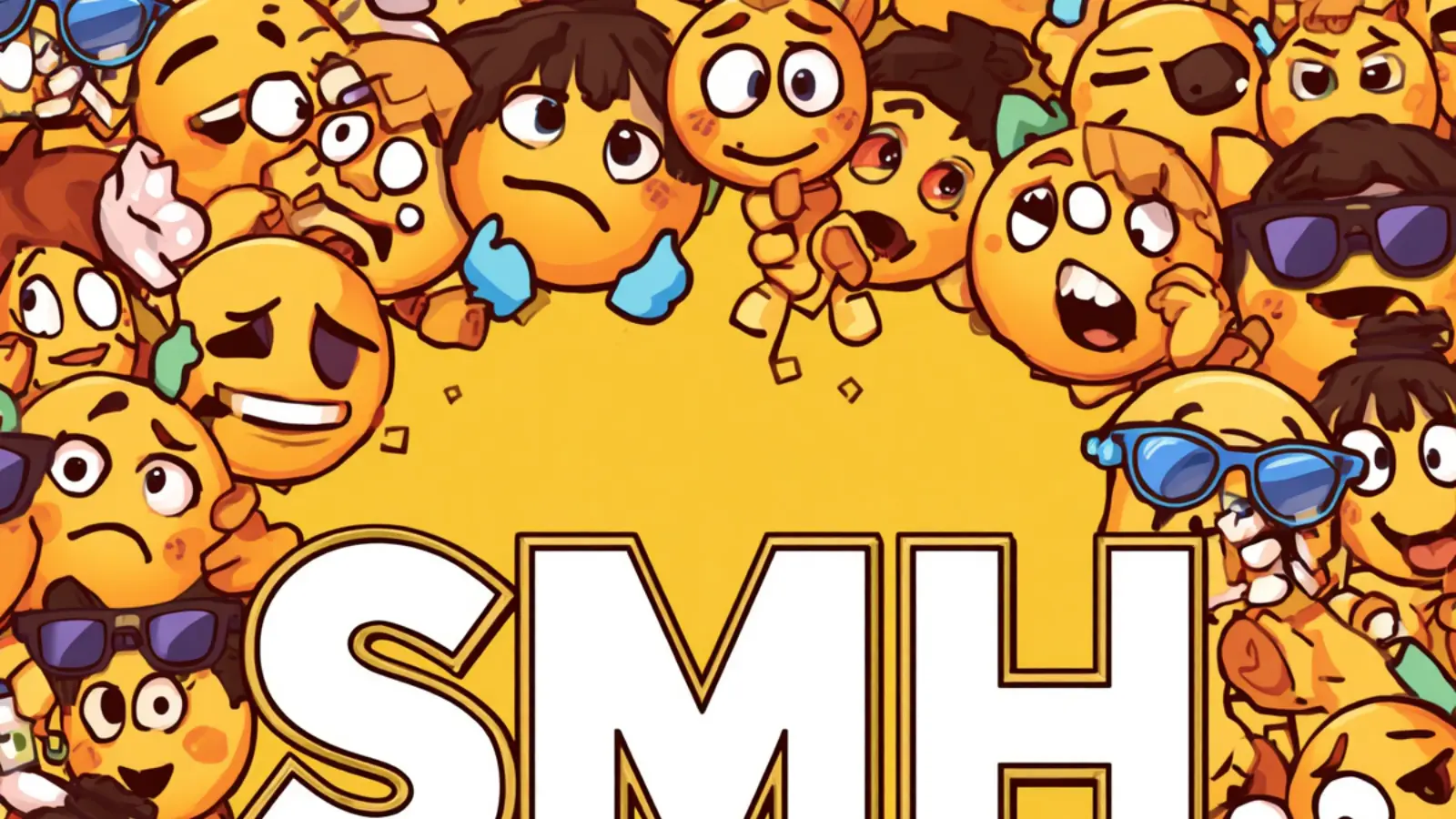
If you have seen SMH in a text, comment, meme, or social-media post and wondered what it means, the answer is simple: SMH stands for “shaking my head.”
It is an informal abbreviation people use when something seems ridiculous, disappointing, frustrating, surprising, or difficult to believe.
Cambridge Dictionary describes it as an abbreviation used in texts and social media when someone does not believe or approve of something.
But SMH is more than a three-letter abbreviation. It communicates a reaction. Instead of writing, “I cannot believe you did that,” someone can simply write, “SMH.”
The phrase suggests the imaginary gesture of shaking one’s head in disbelief or disapproval.
SMH Meaning at a Glance
| Question | Answer |
| What does SMH mean? | Shaking my head |
| What does SMH mean in texting? | A quick way to show disbelief, frustration, disappointment, or disapproval |
| What does SMH mean on social media? | Usually a reaction to something ridiculous, surprising, annoying, or disappointing |
| Is SMH slang? | Yes. It is informal internet and texting slang |
| Is SMH rude? | It can be mildly critical, but it is not automatically rude |
| What does SMDH mean? | “Shaking my damn head,” a stronger version of SMH |
| What does SMFH mean? | “Shaking my fucking head,” a more vulgar and emphatic version |
| Can SMH be funny? | Yes. It is often used playfully or jokingly |
Merriam-Webster defines SMH as “shaking my head” and says it can express disapproval, dismay, or disbelief.
What Does SMH Mean in Everyday Language?
At its core, SMH represents a reaction rather than an object, person, or action.
Imagine a friend tells you:
“I forgot my wallet after driving 30 minutes to the restaurant.”
You might respond:
“SMH 😂”
You are not literally announcing that you are shaking your head. Instead, you are communicating something like:
- “I can’t believe you did that.”
- “Seriously?”
- “What were you thinking?”
- “That’s so frustrating.”
- “I expected better.”
- “This is ridiculous.”
The exact interpretation depends on the surrounding conversation.
This is an important feature of internet slang: a short abbreviation can communicate an entire emotional reaction that would otherwise require a sentence.
Why Does SMH Stand for “Shaking My Head”?
SMH is formed from the first letters of Shaking My Head.
The abbreviation works because head-shaking is a familiar nonverbal reaction. People commonly shake their heads to signal “no,” disbelief, frustration, disappointment, or confusion.
Merriam-Webster notes that SMH works similarly to other internet initialisms such as LOL and BRB, turning a familiar phrase or gesture into a compact form suitable for digital communication.
So when someone writes:
“You really forgot the tickets? SMH.”
the abbreviation essentially recreates the gesture in written form.
That makes SMH particularly useful in text-based communication, where facial expressions, gestures, and tone of voice are missing.
What Does SMH Mean in Texting?
In texting, SMH usually means that the sender is disappointed, surprised, frustrated, or unable to believe something.
For example:
Friend: “I studied for five hours and forgot we had the exam today.”
You: “SMH 😭”
Here, SMH may communicate sympathetic disbelief rather than serious criticism.
Another example:
Friend: “He said he didn’t know the meeting started at 9 even though I reminded him three times.”
Reply: “SMH.”
In this case, the abbreviation probably expresses frustration or disapproval.
Common texting examples
- “You left your phone at home again? SMH.”
- “SMH, I can’t believe that actually happened.”
- “Forgot to charge my laptop. SMH.”
- “SMH 😂 why would you do that?”
- “They canceled it at the last minute. SMH.”
The emoji or punctuation can change the emotional temperature.
For example:
“SMH 😂” often feels playful.
“SMH.” can sound more serious or disappointed.
“SMH!!!” can emphasize frustration.
What Does SMH Mean on Social Media?
On social platforms, SMH is commonly used as a reaction to posts, comments, news, opinions, or situations that the writer finds unbelievable, foolish, frustrating, or disappointing. Cambridge specifically identifies social media and text messages as common contexts for the abbreviation.
For example, someone might see a post saying:
“I drove to the store and realized it was closed.”
A commenter could write:
“SMH 😂”
The comment does not necessarily mean the person is angry. It may simply communicate amused disbelief.
Social-media usage also makes SMH useful as a standalone reaction:
“SMH.”
That short response can function almost like an emoji. The reader is expected to understand the emotional meaning from the post immediately before it.
Is SMH Always Negative?
No. SMH usually signals a negative or disapproving reaction, but the intensity can vary considerably.
This is where context matters.
Mild and playful SMH
“You put ketchup on that? SMH 😂”
This is probably teasing.
Genuine frustration
“They raised the price again. SMH.”
This expresses annoyance or disappointment.
Strong disapproval
“People are still spreading that false information. SMH.”
Here, the writer is expressing stronger criticism.
Amused disbelief
“He wore two different shoes to the interview. SMH 😭”
This may be humorous rather than hostile.
The abbreviation itself does not tell you exactly how angry the sender is. The surrounding words, punctuation, emojis, relationship between the speakers, and subject matter all contribute to the meaning.
How Tone Changes the Meaning of SMH
One of the most useful ways to understand SMH is to treat it as a tone marker.
| Version | Possible tone |
| SMH | Disbelief, disappointment, mild criticism |
| smh | Casual, understated, conversational |
| SMH 😂 | Amused disbelief |
| SMH 😭 | Dramatic or humorous disbelief |
| SMH… | Resignation or disappointment |
| SMH!!! | Stronger frustration |
| SMDH | More emphatic disapproval |
| SMFH | Very emphatic and vulgar disapproval |
Lowercase smh and uppercase SMH generally have the same meaning. Capitalization usually changes presentation rather than definition.
Where Did SMH Come From?
The exact origin of SMH is not completely documented, so it is better to distinguish between confirmed early usage and broader claims about its development.
Merriam-Webster records the abbreviation as being in use at least as early as the 1990s, citing a July 1994 Usenet example that explicitly listed “SMH” as “shaking my head.” Another example from 1998 also used the abbreviation in that sense.
Dictionary.com describes SMH as emerging through digital communication and notes that it became more visible in the 2000s. Its historical account also points to early online usage, including an Urban Dictionary entry from 2004 and spread through Twitter during the late 2000s.
The safest conclusion is that SMH developed within the broader culture of online communication and became increasingly recognizable as internet slang during the 2000s and 2010s.
Its popularity makes sense in the context of digital conversation: early online communities needed compact ways to communicate emotion and tone without the facial expressions or gestures available in face-to-face conversation.
How SMH Became Useful Online
Digital communication has always had a problem: text does not automatically show emotion.
Consider these two messages:
“You did that again.”
Depending on context, this could sound angry, amused, disappointed, or affectionate.
Add:
“You did that again. SMH 😂”
The emotional intention becomes much easier to interpret.
SMH therefore acts as a small piece of digital conversational shorthand. It gives readers a clue about the speaker’s reaction.
This is similar to how other internet abbreviations communicate emotional or conversational information:
- LOL laughing out loud
- OMG oh my God
- IDK I don’t know
- IMO in my opinion
- TBH to be honest
- IKR I know, right?
- SMDH shaking my damn head
These expressions help people communicate quickly without writing complete sentences.
SMH vs. SMDH vs. SMFH
These abbreviations are related, but they are not identical.
SMH
SMH = shaking my head
This is the standard and least intense form.
“He forgot his password again. SMH.”
SMDH
SMDH = shaking my damn head
The added word makes the reaction more emphatic. Merriam-Webster defines SMDH as an informal expression of disapproval, dismay, or disbelief.
“SMDH, how many times do we have to explain this?”
SMFH
SMFH = shaking my fucking head
This is considerably more vulgar and emphatic. Merriam-Webster records it as an informal expression of strong disapproval, dismay, or disbelief.
Because of the profanity, SMFH is less appropriate in professional or formal communication.
SMH vs. “I Can’t Believe It”
These expressions can communicate a similar reaction, but they have different styles.
“I can’t believe it” is ordinary conversational English.
“SMH” is digital shorthand.
Compare:
“I can’t believe he forgot again.”
with:
“He forgot again. SMH.”
The first explicitly states disbelief. The second relies on the reader understanding the slang.
That makes SMH especially natural in texts, comments, group chats, forums, and social-media conversations.
SMH Examples in Realistic Conversations
Example 1: Forgetting something
A: “I left my keys inside the car.”
B: “Again? SMH 😂”
The response is probably teasing rather than hostile.
Example 2: A disappointing situation
A: “The restaurant canceled our reservation.”
B: “SMH. Seriously?”
Here, SMH expresses frustration.
Example 3: A ridiculous mistake
A: “I spent 20 minutes looking for my glasses.”
B: “Where were they?”
A: “On my head.”
B: “SMH 😭”
The abbreviation expresses amused disbelief.
Example 4: Social-media disagreement
Post: “You don’t need to check whether information is true before sharing it.”
Comment: “SMH.”
Here, SMH signals disapproval.
Example 5: Self-directed humor
Post: “I walked into the kitchen and forgot why I was there. SMH.”
This usage is not directed at another person. Someone can use SMH to laugh at or criticize their own mistake.
Can SMH Be Used Sarcastically?
Yes. SMH can be sarcastic, especially when the situation is obviously humorous or exaggerated.
For example:
“I accidentally ordered pizza instead of salad. SMH.”
The person may not genuinely regret the decision. They may be joking about their own behavior.
Similarly:
“SMH, imagine having to eat ice cream twice today.”
This could be intentionally dramatic and humorous.
The key is that SMH does not guarantee seriousness. Context determines whether the reaction is sincere, sarcastic, playful, or critical.
Common Misunderstandings About SMH
1. SMH does not literally require someone to shake their head
The phrase refers to the gesture, but using the abbreviation does not mean the person is physically doing it.
2. SMH does not automatically mean anger
It can express mild disappointment, amusement, disbelief, annoyance, or playful teasing.
3. SMH is not necessarily an insult
Calling something “SMH” may criticize a situation without directly insulting a person.
4. SMH is not the same as LOL
LOL generally signals laughter, while SMH signals disbelief, disapproval, frustration, or a similar reaction.
5. SMH is not a formal abbreviation
It belongs primarily to informal digital communication. It would usually be inappropriate in a formal report, academic paper, or professional business document.
6. “SMH” and “smh” mean the same thing
Capitalization usually does not change the definition.
What Does SMH Mean in Different Contexts?
The easiest way to interpret SMH is to examine what happened immediately before it.
| Context | Likely interpretation |
| Friend makes a silly mistake | Playful disbelief |
| Someone behaves irresponsibly | Disapproval |
| Unexpected bad news | Disappointment |
| Ridiculous social-media post | Criticism or disbelief |
| Someone makes an obvious mistake | “Seriously?” |
| You make a mistake yourself | Self-deprecating humor |
| Absurd situation | Amused disbelief |
| Repeated annoying behavior | Frustration |
The surrounding context is more important than the abbreviation alone.
When Should You Use SMH?
SMH works best when the conversation is informal.
Good situations include:
- Text messages with friends
- Group chats
- Social-media comments
- Online forums
- Casual direct messages
- Memes and humorous posts
- Informal conversations
You should generally avoid it in:
- Formal business emails
- Academic assignments
- Legal documents
- Official reports
- Professional applications
- Formal customer communications
If you are unsure whether the recipient knows internet slang, simply write the reaction out.
Instead of:
“SMH.”
you can say:
“I honestly can’t believe that happened.”
That is clearer for a general audience.
Related Internet Slang You May See With SMH
Understanding SMH becomes easier when you recognize nearby expressions.
SMDH shaking my damn head; a stronger version of SMH.
SMFH shaking my fucking head; a more vulgar and emphatic form.
IDK I don’t know.
TBH to be honest.
IKR I know, right?
OMG oh my God.
LOL laughing out loud.
WTF a vulgar expression of surprise, confusion, or frustration.
These expressions belong to the broader family of internet slang, texting abbreviations, initialisms, and digital communication shorthand.
Does SMH Mean Something Else?
In ordinary internet slang, SMH overwhelmingly means “shaking my head.” Major English dictionaries such as Merriam-Webster and Cambridge define it that way.
However, abbreviations can have different meanings in specialized fields. Dictionary.com, for example, notes that SMH can occur in contexts unrelated to internet slang.
That is why context matters when encountering an abbreviation in technical, organizational, medical, financial, or other specialized material.
If someone sends you:
“SMH 😂”
in a group chat, however, there is little mystery: they almost certainly mean “shaking my head.”
FAQ: What Does SMH Mean?
1. What does SMH mean in texting?
SMH means “shaking my head” in texting. It is used to express disbelief, disappointment, frustration, disapproval, or mild annoyance. For example, if a friend says they forgot their keys for the third time, you might reply, “SMH.” Depending on the relationship and context, the message could be genuinely critical or simply playful. Emojis such as 😂 or 😭 can make the expression feel more humorous or dramatic.
2. What does SMH mean on TikTok?
On TikTok and other social platforms, SMH generally means “shaking my head.” People use it in comments, captions, replies, and messages when reacting to something ridiculous, disappointing, surprising, or difficult to believe. The meaning is not fundamentally different on TikTok; the platform simply provides another setting where internet slang is commonly used. Whether the comment is serious or joking depends on the video and surrounding conversation.
3. Is SMH a bad word?
No. SMH is not a swear word. It is an informal abbreviation for “shaking my head.” However, it can communicate criticism or disapproval, so it may sound negative in some conversations. Related forms such as SMFH contain profanity and are considerably more vulgar. If you are communicating professionally, spelling out your reaction instead of using SMH is usually clearer and more appropriate.
4. What does SMH mean from a girl or guy?
SMH has the same basic meaning regardless of who uses it: “shaking my head.” The sender may be expressing disbelief, frustration, disappointment, teasing, or amusement. Its meaning should not be interpreted differently simply because the sender is a man or woman. Look at the message before SMH, the relationship between the people communicating, and any emojis or punctuation to understand the intended tone.
5. Is SMH rude in a text?
SMH can be mildly rude or dismissive, but it is not automatically rude. Among friends, “SMH 😂” can be playful. In a disagreement, however, “SMH” may communicate that you think the other person’s statement or behavior is foolish. If you want to avoid sounding dismissive, a clearer response such as “I don’t think that’s a good idea” may be better.
6. What is the difference between SMH and SMDH?
Both expressions mean essentially “shaking my head,” but SMDH adds “damn,” making it more emphatic. Merriam-Webster defines SMDH as an informal expression of disapproval, dismay, or disbelief. In practical use, SMH can be relatively mild, while SMDH often conveys stronger frustration. Neither abbreviation automatically indicates anger; context still determines the emotional tone.
7. Where did SMH come from?
SMH developed as an abbreviation in digital communication. Merriam-Webster documents examples dating back at least to the 1990s, including a 1994 Usenet example explicitly defining SMH as “shaking my head.” Dictionary.com describes its growth through online communication and notes greater visibility during the 2000s and later. Its exact single point of origin is not firmly established.
8. Can you use SMH for yourself?
Yes. SMH can describe your own reaction to your own mistake. For example, after forgetting an appointment, someone might post, “Forgot my appointment again. SMH.” This is often self-deprecating rather than genuinely angry. In this context, the writer is essentially saying, “I can’t believe I did that.” Self-directed SMH is especially common in humorous posts and casual conversations.
9. What does lowercase “smh” mean?
Lowercase “smh” means exactly the same thing as uppercase “SMH”: “shaking my head.” People often use lowercase versions because casual digital communication does not require capitalization. In some conversations, lowercase text can feel more relaxed or understated, but there is no separate dictionary definition attached to lowercase smh.
10. What does SMH mean in slang?
In slang, SMH means “shaking my head,” an expression of disbelief, disapproval, frustration, disappointment, or annoyance. It is an internet initialism commonly found in texts, comments, social-media posts, and online conversations. The exact emotional strength depends on context. It can be serious, sarcastic, humorous, or lightly teasing.
Final Answer: What Does SMH Mean?
So, what does SMH mean?
SMH stands for “shaking my head.” It is informal internet and texting slang used when someone wants to communicate disbelief, frustration, disappointment, disapproval, or amused disbelief without writing a full sentence.
Its meaning is usually easy to understand from context:
“He forgot his wallet again. SMH.”
means something like:
“Seriously? I can’t believe he did that again.”
The expression became part of online communication because it turns a familiar physical reaction shaking your head into a compact written response.
Documented uses go back at least to the 1990s, while the abbreviation became increasingly visible as internet and social-media communication expanded.
Whether SMH sounds funny, annoyed, disappointed, sarcastic, or genuinely critical depends on the situation, the relationship between the speakers, and clues such as emojis and punctuation.
In short: SMH = shaking my head = “I can’t believe this,” “seriously?” or “that’s disappointing,” depending on context.

Find trending pickup lines, funny dating jokes, and flirty messages to impress anyone instantly.