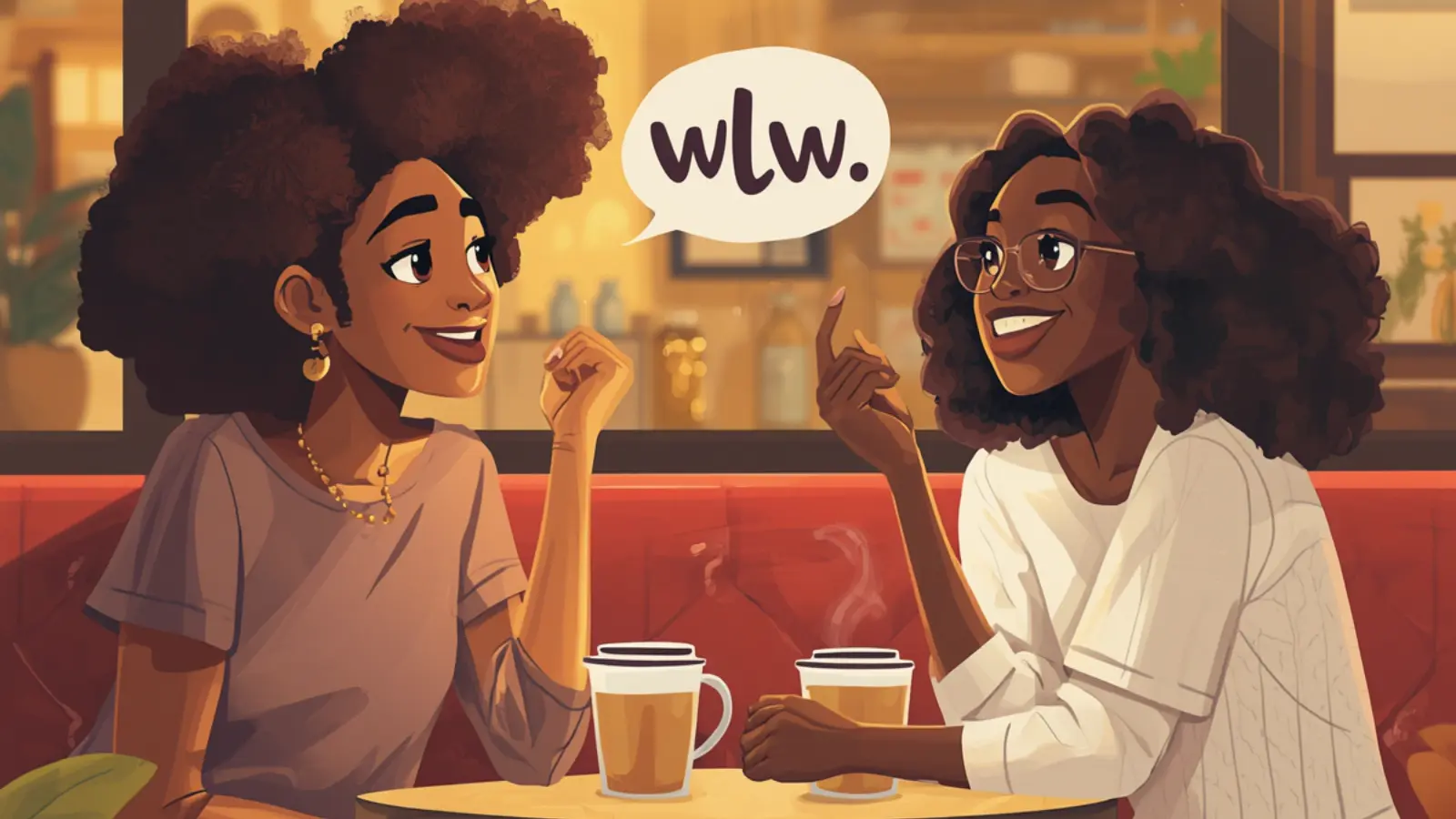
WLW means “women loving women.” It is an inclusive term describing women who experience romantic or sexual attraction toward women.
WLW can include lesbians, bisexual women, pansexual women, queer women, and others who identify with attraction between women.
The abbreviation is especially common in LGBTQ+ communities, social media, dating conversations, and online discussions.
What Does WLW Mean?
If you have seen “WLW” on TikTok, Instagram, dating profiles, Reddit, Tumblr, or LGBTQ+ discussions, you may wonder what it means. WLW stands for “women loving women.” It is generally used as an umbrella term for women who are attracted to other women, whether that attraction is romantic, sexual, or both.
Unlike a label such as “lesbian,” WLW does not necessarily specify a person’s sexual orientation. A woman using the term might identify as lesbian, bisexual, pansexual, queer, or another identity—or may simply prefer a descriptive phrase rather than a specific label.
The exact meaning can also depend on context. In a social-media post, “WLW” might describe a relationship, fictional couple, dating experience, community, piece of media, or content intended for women attracted to women.
WLW Meaning at a Glance
| Term | Meaning | Typical use |
| WLW | Women loving women | Broad umbrella description |
| Lesbian | A woman primarily or exclusively attracted to women | Sexual-orientation identity |
| Sapphic | Relating to women or non-men attracted to women, with some variation in usage | Cultural, romantic, or literary contexts |
| MLM | Men loving men | Broad counterpart to WLW |
| Queer | A broad identity term for people whose sexuality or gender does not fit conventional categories | Identity and community contexts |
| Bi | Someone attracted to more than one gender | Specific sexual-orientation identity |
The important distinction is that WLW describes a pattern of attraction, while many other terms describe an identity someone chooses for themselves.
Why People Use WLW Instead of a Specific Sexuality Label
One reason WLW has become useful online is its inclusiveness.
A person may know that she is attracted to women without wanting to define herself as lesbian, bisexual, or another particular identity. WLW gives her a way to describe that experience without requiring a more specific label.
For example:
- A bisexual woman may describe her relationship with another woman as a WLW relationship.
- A lesbian couple may be described as a WLW couple.
- A queer woman may search for WLW books, movies, or communities.
- Someone questioning her sexuality may find WLW content relevant without choosing an identity label yet.
This makes WLW particularly useful when the focus is the relationship or attraction rather than the individual’s complete identity.
WLW Does Not Automatically Mean Lesbian
This is one of the most important distinctions.
All lesbian women can generally fall under the WLW umbrella, but not everyone described as WLW is necessarily lesbian.
For instance, a bisexual woman who dates another woman can accurately describe that relationship as WLW. Calling her a lesbian, however, would impose a specific identity she may not use.
The safest approach is to use the label a person uses for herself.
What Does WLW Mean in Texting?
In texting, WLW usually has the same meaning: “women loving women.”
It can appear as a short reference in conversations where people already understand LGBTQ+ terminology.
Examples include:
“Do you know any good WLW movies?”
This means the person is asking for movies featuring or focused on relationships or attraction between women.
“My favorite WLW couple is finally getting their own storyline.”
Here, WLW describes the relationship between two female characters.
“I joined a WLW dating app.”
In this context, WLW indicates that the service or community is intended for women interested in women.
Because abbreviations depend heavily on context, someone unfamiliar with LGBTQ+ terminology might interpret WLW differently. In ordinary social-media and relationship discussions, however, “women loving women” is the established interpretation.
How WLW Is Used on Social Media
WLW is especially common in online communities because short abbreviations make it easier to categorize conversations and content.
You may see phrases such as:
- “WLW content”
- “WLW couple”
- “WLW romance”
- “WLW representation”
- “WLW dating”
- “WLW books”
- “WLW creators”
- “WLW community”
- “WLW TikTok”
- “WLW memes”
On platforms where users search through hashtags, keywords, or community labels, WLW can function as a broad description of content involving women attracted to women.
What Does WLW Mean on TikTok?
On TikTok, WLW generally means “women loving women.” It may appear in videos about dating, relationships, sexuality, pop culture, fictional couples, personal experiences, humor, or LGBTQ+ representation.
A creator might describe a video as WLW content because it is relevant to women who are attracted to women.
The term does not necessarily tell you whether the creator or people shown identify as lesbian, bisexual, queer, or another orientation. The content category and the individual’s identity are separate things.
Where Did the Term WLW Come From?
WLW belongs to a broader family of descriptive abbreviations used within LGBTQ+ communities and online spaces.
Its counterpart MLM, meaning “men loving men,” is similarly used to describe attraction or relationships involving men. These terms emphasize the people involved rather than requiring a particular identity label.
The underlying phrase “women loving women” is descriptive rather than a newly invented sexual orientation. The abbreviation became especially practical as internet communities developed shared terminology for discussing LGBTQ+ relationships and representation.
There is not one universally accepted moment when WLW was “invented.” Its development is better understood as part of the evolution of LGBTQ+ vocabulary, online communities, and identity-neutral language.
That distinction matters because internet slang often has a complicated history. A particular website, post, or creator may popularize an abbreviation without actually being its original source.
WLW vs. Lesbian: What’s the Difference?
The terms overlap, but they are not interchangeable in every situation.
| WLW | Lesbian |
| Broad descriptive term | Specific sexual-orientation identity |
| Focuses on women attracted to women | Usually refers to women whose attraction is primarily or exclusively toward women |
| Can include bisexual and pansexual women | Describes people who identify as lesbian |
| Useful when identity is unknown or irrelevant | Appropriate when someone uses the lesbian label |
| Common in online communities and media discussions | Common as a personal identity and community term |
Consider a fictional example:
Sara identifies as bisexual and is dating Mia.
You could describe Sara and Mia as a WLW couple because their relationship involves two women. Calling Sara a lesbian would not accurately represent the identity she has chosen.
WLW vs. Sapphic
Sapphic is another related term, but it has its own history and nuances.
The word comes from Sappho, the ancient Greek poet associated with poetry about women and desire. Today, “sapphic” is commonly used in literary, cultural, artistic, and LGBTQ+ contexts to describe women-centered attraction or relationships.
WLW is usually more straightforward:
- WLW: women loving women
- Sapphic: a broader cultural/literary term associated with women or non-men experiencing attraction to women, depending on how the speaker uses it
The boundaries of “sapphic” can vary between communities, so context matters.
What Does a WLW Relationship Mean?
A WLW relationship simply refers to a romantic or intimate relationship involving women who are attracted to women.
The phrase itself does not establish:
- How the people involved identify
- Whether they are dating or married
- Whether they are sexually active
- Whether their relationship is monogamous
- How long they have been together
- What gender labels they use
In other words, WLW describes the gender relationship and attraction involved, not every detail of the relationship.
A WLW relationship can look just as varied as any other relationship. The label does not prescribe a particular personality, appearance, behavior, or relationship dynamic.
Examples of WLW in Real Conversations
Seeing the term in context makes its meaning much easier to understand.
Example 1: Entertainment
“I’m looking for more WLW romance novels.”
Meaning: The person wants romance stories centered on relationships between women.
Example 2: Dating
“I’m new to WLW dating.”
Meaning: The person is talking about dating women, perhaps for the first time.
Example 3: Social Media
“This account posts mostly WLW content.”
Meaning: The account focuses on content relevant to women attracted to women.
Example 4: Television
“That show has surprisingly good WLW representation.”
Meaning: The show portrays relationships or characters representing women attracted to women.
Example 5: Personal Identity
“I’m still figuring things out, but WLW content really resonates with me.”
Meaning: The person relates to content about women attracted to women without necessarily specifying an identity label.
Common Misunderstandings About WLW
1. WLW does not mean every woman involved is lesbian
A WLW relationship can involve bisexual, pansexual, queer, lesbian, or other women. The acronym describes the relationship or attraction, not necessarily each person’s orientation.
2. WLW is not itself always an identity label
Some people use WLW as a community or descriptive term rather than saying, “WLW is my sexual orientation.”
3. WLW does not tell you someone’s gender identity
The abbreviation refers to women and attraction involving women. It should not be used to make assumptions about a particular person’s gender identity.
4. WLW is not limited to romantic relationships
Depending on context, it can refer to romantic attraction, sexual attraction, relationships, media representation, or broader community content.
5. The abbreviation is not automatically sexual
WLW can appear in discussions about romance, friendship, literature, television, representation, dating, or identity. Context determines what aspect is being discussed.
6. You should not assign the label to someone against their wishes
Even if a person’s relationship could technically be described as WLW, their preferred identity and terminology should take priority when discussing them personally.
Why WLW Is Useful in LGBTQ+ Conversations
Language can help people communicate without forcing every experience into a narrow category.
WLW is particularly useful when the speaker wants to discuss shared experiences among women attracted to women without assuming everyone has the same identity.
For example, a discussion about dating women might include lesbians, bisexual women, queer women, and women who are still questioning their sexuality. “WLW dating” can describe the topic without requiring everyone involved to use one particular label.
The term is therefore often more about inclusion and description than about defining a person’s complete identity.
Related Terms You May See Alongside WLW
If you’re encountering WLW online, several neighboring terms may appear.
LGBTQ+
An umbrella acronym covering lesbian, gay, bisexual, transgender, queer/questioning, and additional identities represented by the “+.”
Lesbian
A sexual-orientation identity generally describing women who are attracted primarily or exclusively to women.
Bisexual
A term commonly used by people who experience attraction to more than one gender.
Pansexual
A sexual-orientation term often used by people who describe attraction regardless of gender or who experience attraction across genders.
Queer
A broad term some people use to describe sexuality or gender outside conventional categories. Not everyone uses or prefers it, so it should not be imposed on others.
MLM
“Men loving men,” commonly used as a broad counterpart to WLW.
Sapphic
A term connected historically to Sappho and now widely used for women-centered attraction, relationships, literature, and culture.
How Context Changes the Meaning of WLW
Although “women loving women” is the standard interpretation, the practical meaning can shift slightly according to the setting.
| Context | Likely meaning |
| Dating profile | Interested in or discussing women attracted to women |
| TikTok | Content involving women attracted to women |
| Book recommendation | Romance or stories involving women loving women |
| TV discussion | Female same-sex relationships or representation |
| LGBTQ+ community | Broad category involving attraction between women |
| Text message | Short form of “women loving women” |
| Relationship discussion | A relationship between women |
| Identity discussion | May describe someone’s experience without specifying orientation |
This is why reading the surrounding sentence is more useful than treating every abbreviation as having only one rigid application.
Is WLW the Same as W/W or F/F?
Not exactly, although the concepts can overlap.
W/W or F/F may be used to indicate a relationship between two women or female characters, particularly in fiction, fan communities, or content categorization.
WLW emphasizes women loving women and is frequently used in LGBTQ+ community and identity-related conversations.
The terminology is not perfectly standardized across every website or community, so users should pay attention to how a particular group defines its labels.
Frequently Asked Questions About WLW
What does WLW stand for?
WLW stands for “women loving women.” It is an umbrella or descriptive term commonly used for women who experience attraction toward women. The phrase can describe romantic or sexual attraction, relationships, media representation, dating experiences, or online communities. It does not necessarily identify someone as lesbian because bisexual, pansexual, queer, and other women may also use or fall under the term. In everyday internet usage, you will often see WLW attached to discussions about dating, books, movies, television characters, social-media communities, and relationships between women.
What does WLW mean in texting?
In texting, WLW normally means “women loving women.” Someone might use it when discussing dating, relationships, entertainment, or LGBTQ+ topics. For example, “Do you have any WLW book recommendations?” means the person wants recommendations involving relationships or attraction between women. Because WLW is an abbreviation, its meaning technically depends on context, but “women loving women” is the standard interpretation in LGBTQ+ and social-media conversations. It is generally used as a convenient shorthand rather than as a secret code or inherently sexual expression.
What does WLW mean on TikTok?
On TikTok, WLW generally refers to women loving women and is commonly used to categorize videos, jokes, relationship discussions, personal stories, dating experiences, fictional couples, and LGBTQ+ representation. A TikTok described as WLW content is generally aimed at or relevant to women who are attracted to women. Importantly, the label does not tell you the creator’s exact sexual orientation. A bisexual, lesbian, pansexual, queer, or questioning person may all interact with WLW content.
Does WLW mean lesbian?
No, not necessarily. WLW is broader than lesbian. “WLW” describes women attracted to women, while “lesbian” is a specific sexual-orientation identity. A bisexual woman dating another woman can be part of a WLW relationship without identifying as lesbian. Similarly, a queer or pansexual woman may use WLW to describe her relationship or the content she enjoys. When referring to a specific person, their own identity label should be respected rather than assumed from the relationship.
What is a WLW relationship?
A WLW relationship is generally a romantic or intimate relationship involving women who are attracted to women. The term describes the gender and attraction aspect of the relationship but does not establish other details. A WLW couple could have different sexual orientations, relationship structures, personalities, cultures, or life experiences. The phrase is therefore useful as a broad description without implying that every couple or individual follows the same identity or relationship model.
What does WLW stand for in LGBTQ+ contexts?
Within LGBTQ+ contexts, WLW stands for “women loving women.” It is useful because it can describe attraction or relationships without requiring every person involved to use the same sexual-orientation label. For example, a conversation about WLW dating might include lesbians, bisexual women, queer women, and others attracted to women. The term is especially useful when the topic is the shared experience of women being attracted to women rather than the precise identity of every individual.
Is WLW the same as sapphic?
WLW and sapphic overlap, but they are not identical terms. WLW directly means women loving women, while “sapphic” has historical and cultural roots connected to the Greek poet Sappho and is now used for women-centered attraction, relationships, art, and literature. Different communities use “sapphic” somewhat differently. WLW is usually the more direct and easily decoded phrase, while sapphic can carry additional literary and cultural associations.
What does WLW mean in books and movies?
In books, movies, and television, WLW commonly describes stories, characters, or relationships involving women attracted to women. A “WLW romance” usually centers on a romantic relationship between women. A discussion of “WLW representation” may focus more broadly on how women-loving-women characters and relationships are portrayed. The term can therefore refer to romance, drama, comedy, coming-of-age stories, or other genres rather than one specific type of story.
Can bisexual women be WLW?
Yes. A bisexual woman can absolutely be part of the WLW category or describe a relationship with another woman as WLW. This is one of the reasons the term is broader than “lesbian.” WLW describes attraction or relationships involving women, whereas bisexuality describes an individual’s sexual orientation. A person can therefore accurately use both concepts without contradiction: for example, a bisexual woman can be in a WLW relationship.
Why do people say WLW instead of lesbian?
People may use WLW because it is broader and less identity-specific. Someone might want to discuss women attracted to women without assuming that everyone involved identifies as lesbian. The term can also be convenient when discussing media, dating, relationships, or community experiences rather than someone’s personal identity. For some people, it provides language that feels more inclusive or flexible. Ultimately, whether someone prefers WLW, lesbian, bisexual, queer, sapphic, or another term is personal.
Final Takeaway: What Does WLW Mean?
WLW means “women loving women.” It is a broad term used to describe women who are attracted to women and can include lesbian, bisexual, pansexual, queer, and other women depending on how the term is being used.
The most important distinction is that WLW describes attraction, relationships, or a broader category; it does not automatically tell you someone’s specific sexual identity.
So when you encounter “WLW” in a text, dating profile, TikTok, book recommendation, fandom discussion, or LGBTQ+ conversation, the safest interpretation is women loving women, with the surrounding context explaining exactly what the speaker means.
Discover cute pickup lines, clever rizz jokes, and romantic conversation ideas for social media and texting